Genius Travels has launched the World Travel Safety Score, a free tool that ranks all 226 countries and territories covered by UK Foreign Office travel advice, from the safest places to visit to the most dangerous. It went live on 27 July 2026 and is built from the current advice for every destination, rebuilt in full each time that advice changes.
The tool exists to answer a question that is surprisingly hard to answer today. Anyone planning a trip can find official government FCDO advice for their destination, but it is published as 226 separate pages running to several thousand words each. Plus the map provided by the FCDO only shows where formal advisories have been drawn. The Genius Travels Safety Map solves that putting all the data in one simple map and table for travellers to use.
At a Glance
- 226 countries and territories scored and ranked from safest to most dangerous
- Three views an interactive world map, a searchable table and a monthly report
- 164 countries, or 73% currently sit in the safe or generally safe bands
- Free to use with no account, sign up or app required
- Rebuilt on every change to the underlying government advice
The World Travel Safety Score reads the full advice text for every country from the FCDO and presents the result in an easy to use map and table.
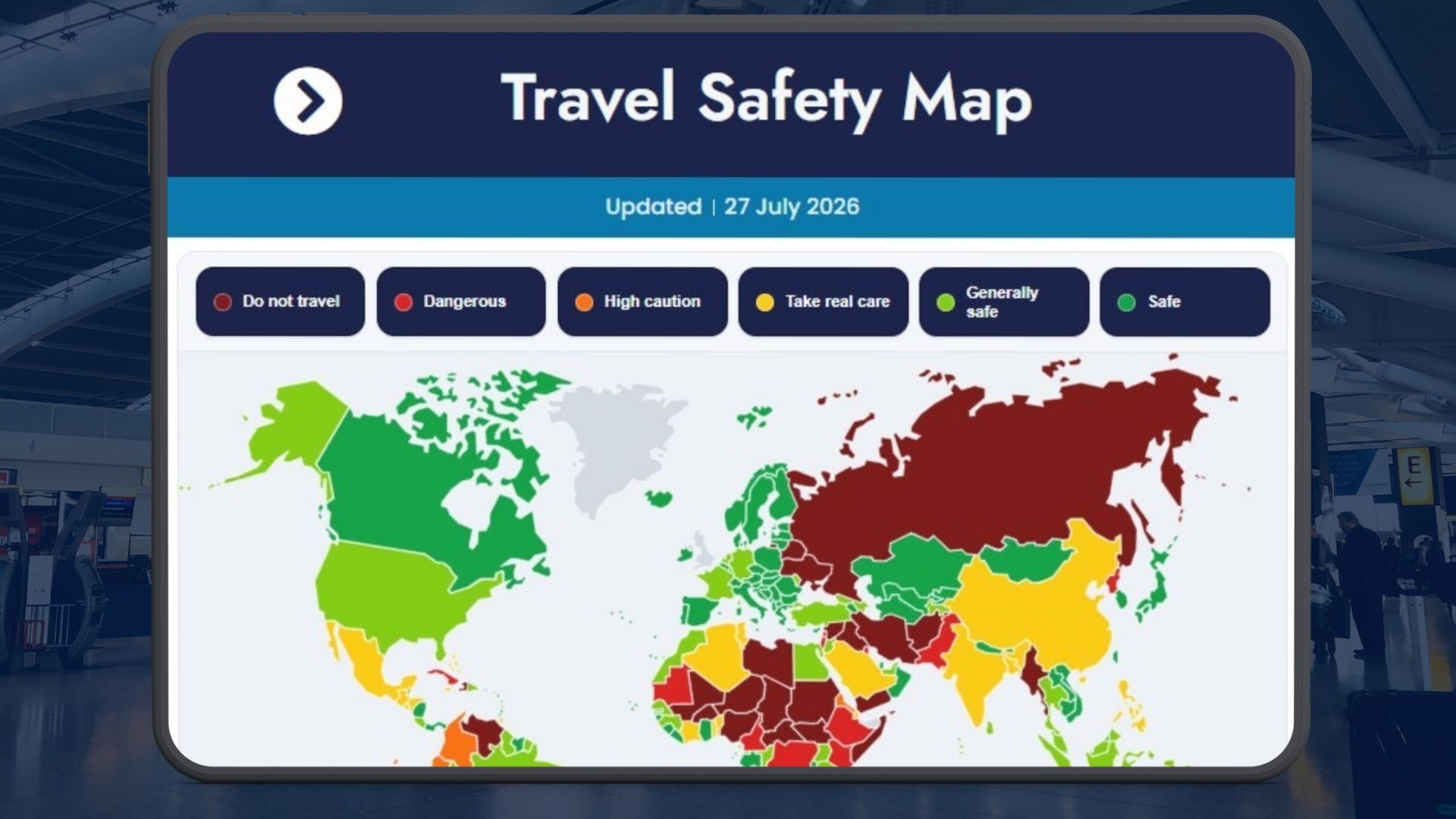
Interactive Travel Safety Map
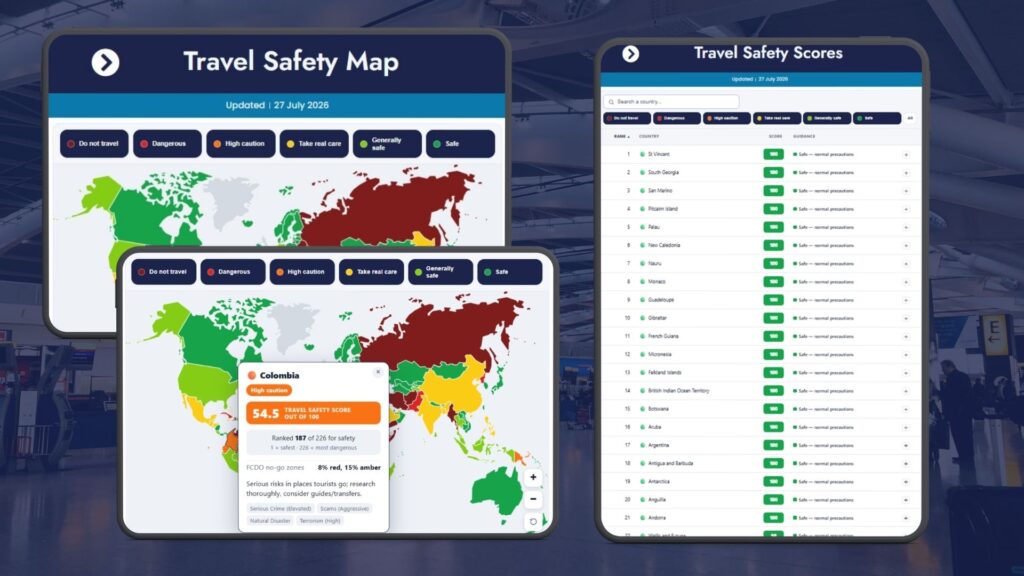
The Travel Safety Map colours every country by its band, from Safe through to Do not travel, with a legend that lets readers filter to the level they care about. Clicking any country opens a card showing its score out of 100, its band, its rank out of 226, a plain English line on what that means in practice, and the specific risk factors that reduced its score. Nothing is hidden behind a summary, so a reader can see exactly why a country sits where it does.

Travel Safety Table
The Travel Safety Scores table lists every country in rank order and can be searched by name or filtered by band. Someone weighing up four possible destinations can check all four in under a minute, which is the point. The Travel Safety Report sits underneath both, summarising how the world currently splits across the bands and explaining what has moved since the previous update and why.

Searching for Travel Safety Information
For readers who already know where they are going, the table score is quickly searchable. Searching Mexico, for example, returns it at 182nd of 226 with a score of 61 and a Take real care band, reflecting the violent crime and the aggressive scams described in the advice, while the formally warned areas are the border and cartel affected states rather than Cancun, Tulum or the Riviera Maya.
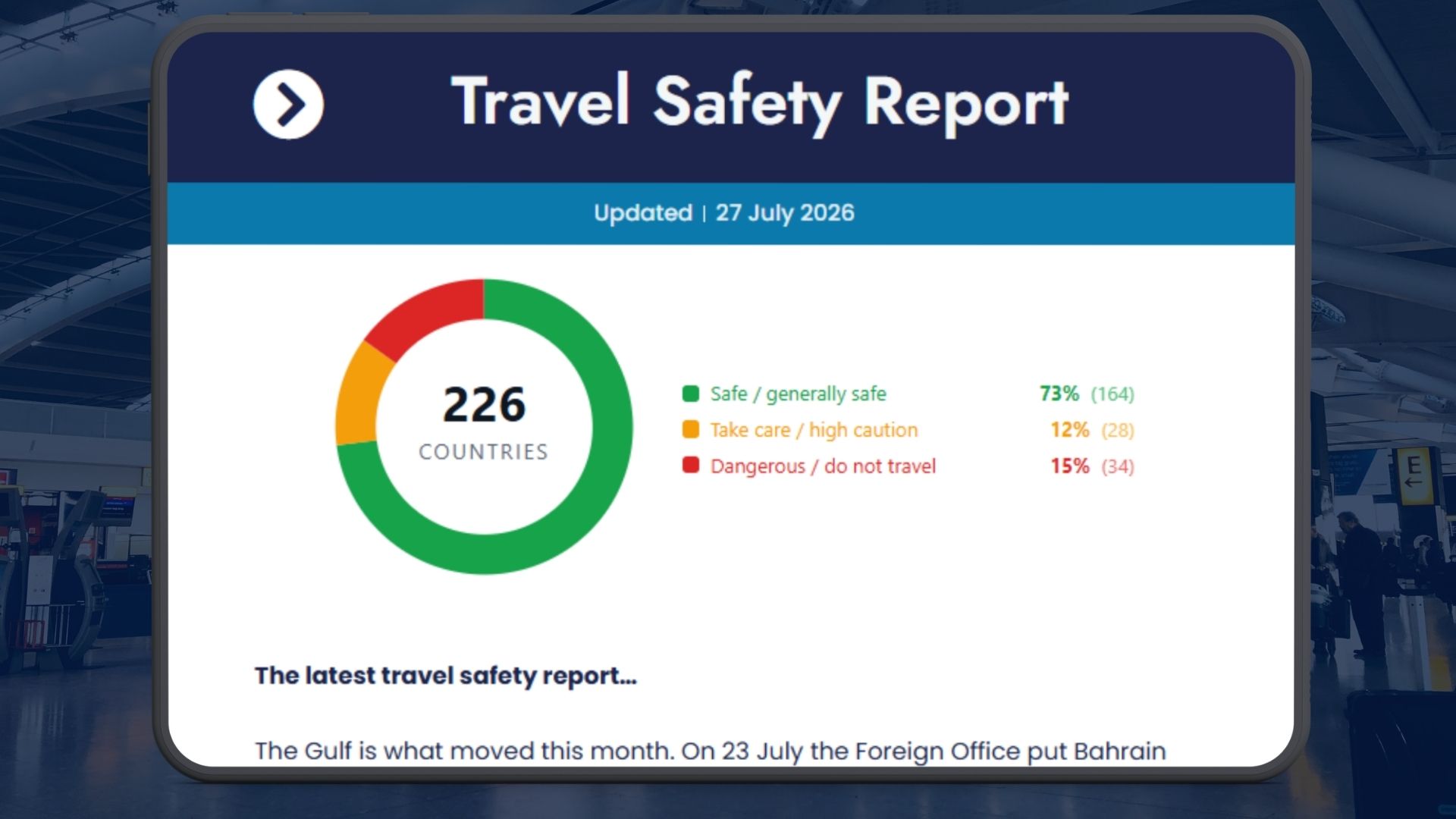
Travel Safety Report
Genius Travels also provide a regular full world travel report to summarise what is going on around the world. At launch, 164 of the 226 countries scored, or 73% of the list, sit in the safe or generally safe bands. A further 28 fall into take real care or high caution, and 34 are rated dangerous or do not travel. The headline finding, and one worth stating plainly in a category of content that tends towards alarm, is that most of the world is perfectly fine to visit and the value of scoring all of it is in identifying the small number of places that are not.
The launch dataset also captures a significant month for the Gulf. On 23 July the Foreign Office moved to advise against all but essential travel to the whole of Bahrain and the whole of Kuwait, following strikes and retaliatory attacks by Iran across the region since 8 July, with Bahrain having had its previous warning lifted only in June. Because both advisories cover the entire country including the capital, both fell sharply in the rankings. Their neighbours did not follow, and the UAE, Qatar and Oman all refreshed their advice in the same week without carrying any territorial warning at all.
Movement runs in both directions, which is part of why the tool is rebuilt rather than set once. Saudi Arabia gained a band this month as its advisory narrowed to a strip along the Yemen border and the older zone covering Riyadh and the Eastern Province was removed. Turkey also improved after its south eastern zone was lifted, leaving only a 10km strip along the Syrian border. Very little of this movement reaches mainstream news coverage, and almost none of it reaches travellers who booked months earlier.

How the Score Is Built
Every country begins on 100 points and loses them across four areas. The first is territorial, measuring how much of the country sits under a formal advisory as a share of its land area, so that a 10km border strip costs very little and a whole country advisory costs a great deal. The second reads the advice text itself and grades it by how strongly it is worded, covering serious crime, terrorism, the risk of arbitrary detention, healthcare quality, scams, and laws affecting women and LGBT travellers.
The third asks whether anyone could help if something went wrong, because a country where consular support is unavailable or severely limited is a materially different proposition, and that carries its own deduction. The fourth is the tourist adjustment described above, which is applied last and is the single largest differentiator between the score and the raw official picture.
The United States illustrates how the components combine. It scores 86 and ranks 133rd of 226, placing it in Generally safe, and the two factors holding it there are a high terrorism rating and natural disaster exposure rather than any warning about crime against visitors. Because the card lists those factors by name, a reader can see the reasoning rather than being asked to accept a number.
On methodology, Genius Travels is deliberately transparent. Every deduction is tied to the wording of the official advice, and the relevant quote and source link are recorded for each one. The weightings applied to those factors, the band thresholds and the tourist adjustment are the publication’s own editorial judgement rather than government policy, and the tool is presented as a dated snapshot to help travellers shortlist rather than as a substitute for checking official advice before departure.
Simon Bengeman, Genius Travels

Travel Advice in One System
The clearest illustration of the gap the tool fills is the group of countries that carry no territorial advisory whatsoever, and therefore appear completely clear on the official map, but whose advice text describes serious crime in detail. Jamaica scores 62, South Africa 63, Chile 65 and the Bahamas 68, and all four sit in the Take real care band despite there being no formal warning against travel to any part of them.
Chile is the most striking case. The official advice describes pickpocketing, mugging and thefts from vehicles as very common across the country, then sets out the specific techniques used on British visitors, including the liquid spill distraction, the deliberately punctured tyre and the roadside stranger offering help. All of it is concentrated in central Santiago and Valparaiso, which are precisely the two places most visitors base themselves. None of that detail is visible on a map that shows Chile as clear, and the score exists to surface it.

FCDO Red & Amber Zones
The tool works just as hard in the opposite direction, and this is the half that matters most to anyone who has cancelled a trip after glancing at an alarming looking map. Plenty of countries carry serious advisories over regions that no holidaymaker was ever going to visit, and the national picture makes them look far worse than the trip in question would actually be.
The Philippines carries warnings across western and central Mindanao and the Sulu islands, while Manila, Cebu, Palawan and Boracay sit well outside every one of them. Colombia follows the same pattern, with the named zones covering border and rural areas rather than Bogota, Cartagena, Medellin or the coffee region. Mozambique carries a serious warning over Cabo Delgado in the far north, roughly a thousand miles from Maputo and the southern beaches. Kenya is flagged along its north eastern border, not across the Maasai Mara, Nairobi or the Diani coast.
In each case the travel safety score records separately whether the warned areas touch the places visitors actually go, and states the reasoning in plain words on the country card. A reader does not have to work out for themselves whether a region name they have never heard of is anywhere near their hotel.
Availability
The World Travel Safety Score is free to use, requires no account or sign up, and works on mobile and desktop. The map, the full ranked table and the current report are all available at geniustravels.co.uk/world-travel-safety-score. Travellers are encouraged to use it alongside the official government advice for their destination, and to check that advice again shortly before they fly, since it can change at short notice.
About Genius Travels
Genius Travels is a UK travel publication covering destinations, accommodation, activities and equipment, alongside travel news and deals for British travellers. The World Travel Safety Score is its first free public data tool.