
This is a developing story. Last updated 14 August 2026.
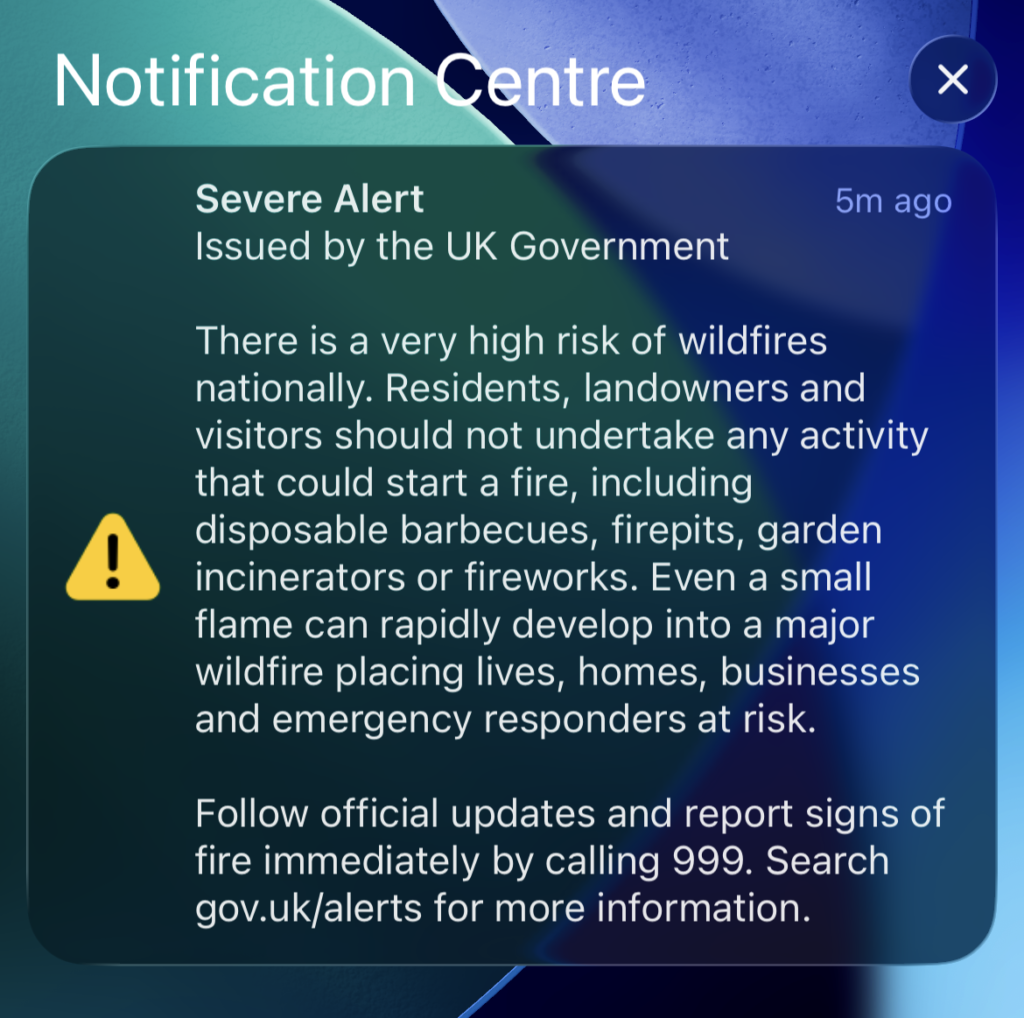
A UK wildfire emergency alert reached mobile phones across England and Wales from about 7pm on Friday 14 August 2026, sent by the Cabinet Office while fire crews fought major incidents in South Wales and the West Midlands. The message told people not to light anything that could start a fire but the government website only published the alert in Welsh.
If you are camping, walking or holidaying in the UK this weekend, please take caution and listen to official advice. Disposable barbecues have been withdrawn from sale across Great Britain, campfires are off in the open countryside, and a garden fire pit is now the wrong idea in most of the country even in your own house.
Most of England and Wales is not burning however there are large area in South Wales and parts of the West Midlands which are having increasinly dangerous fires, and the army has been sent to help.
The Key Facts
- Sent at 6:57pm on 14 August 2026 to phones across England and Wales
- 100 military personnel deployed to support South Wales Fire and Rescue Service
- Disposable barbecues withdrawn from sale across Great Britain while conditions stay dangerous
- Two Welsh fire services are at major incident status
- Call 999 the moment you see fire or smoke in open country
What The Alert Actually Said
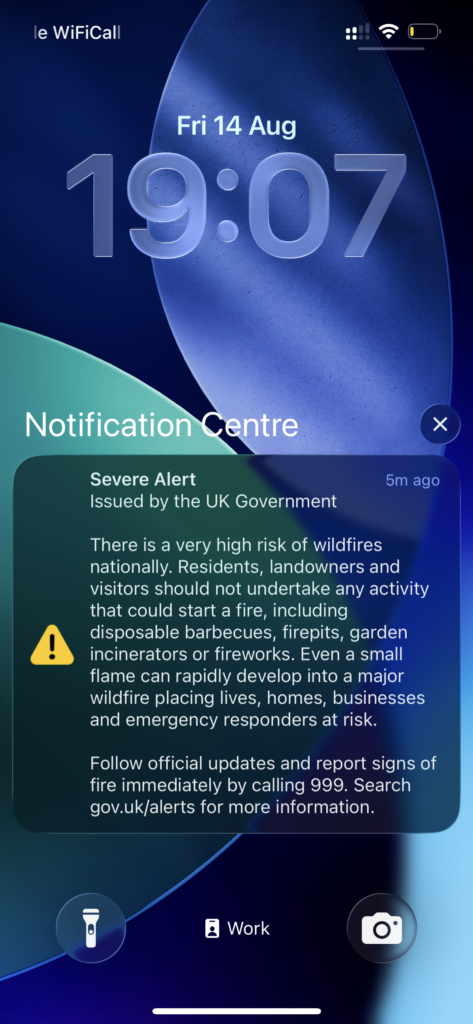
The alert warned of a very high risk of wildfires nationally and told residents, landowners and visitors not to undertake any activity that could start a fire, naming disposable barbecues, fire pits, garden incinerators and fireworks. It asked people to report any sign of fire by calling 999.
The Cabinet Office said the message would go out on a rolling basis from around 19:00 to people across England and Wales, alongside emergency funding for the fire and rescue services under the heaviest operational pressure. The full text is logged at gov.uk/alerts/current-alerts.
“It will be the most extensive emergency use of the alert system to date.”
The government is poised to send an emergency alert to the phones of everyone in England and Wales tonight about the growing threat posed by wildfires.
— Steven Swinford (@Steven_Swinford) August 14, 2026
The Alert Went Out In English. The Website Published It In Welsh.
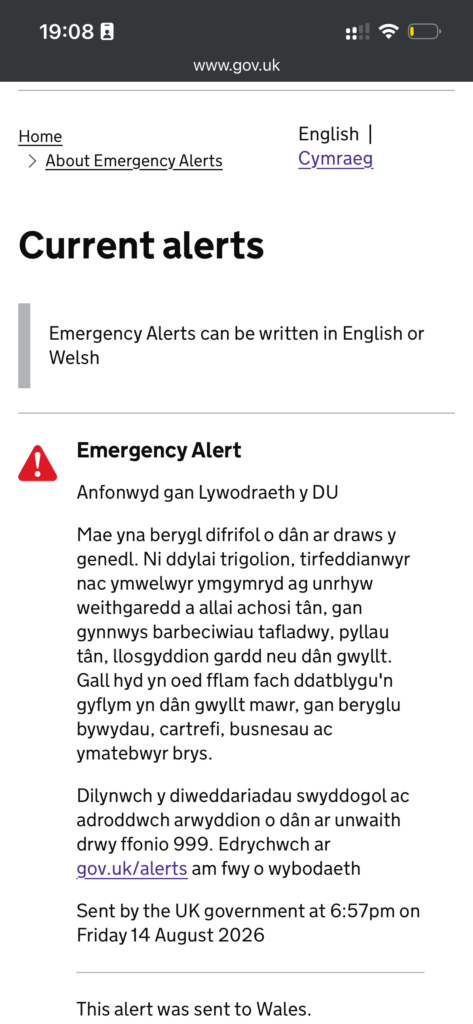
Phones across England and Wales buzzed with an alerte message at 7.00pm alongside a loud warning sound. The government’s own website of live alerts carried that same message in Welsh only. Even on the English page and the Welsh page, which were serving identical Welsh text..
The second discrepancy is arguably the bigger one. The Cabinet Office said the alert was going to England and Wales. The page logging it was in Welsh alone, which leaves an English reader who received the alert with no confirmation from the Government website that the alert was for them. Hopefully they don’t send out another alert that they’ve now corrected their website.
Where Is Actually Affected
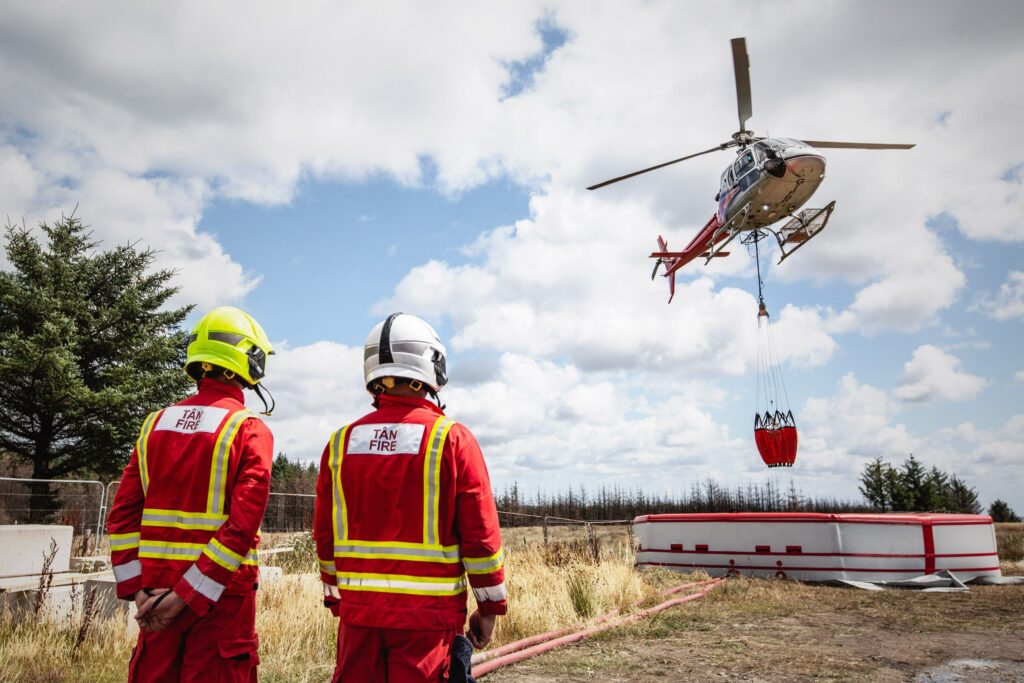
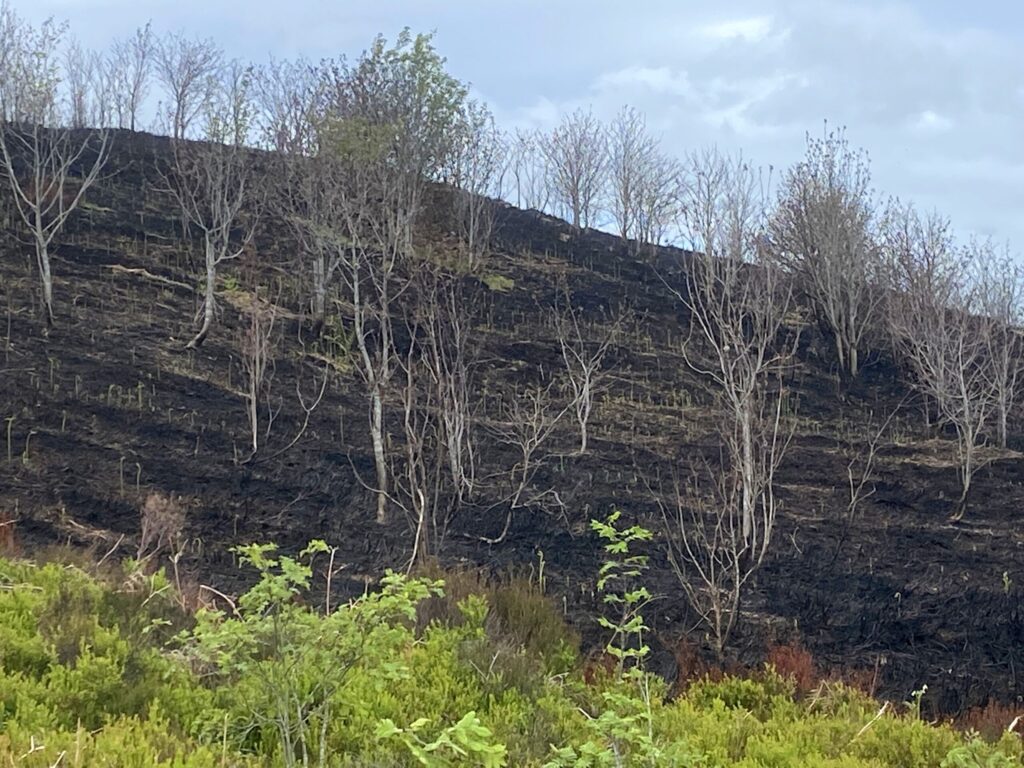
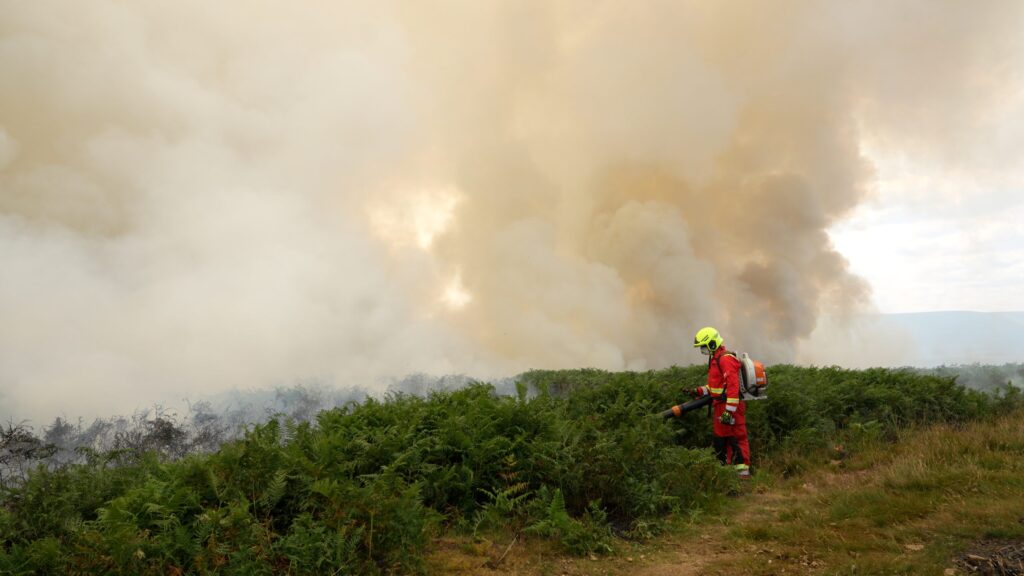
South Wales Fire and Rescue Service has declared a major incident, with fires burning at Blaenavon and Porth among other locations, and has requested military aid. Mid and West Wales Fire and Rescue Service has also declared a major incident. Residents in Newbridge have lost their homes.
Prime Minister Andy Burnham, speaking from Stourbridge in the West Midlands, said 100 military personnel had been deployed initially to the major incident in South Wales and called that support critically needed. The Welsh Government confirmed in its written statement on 14 August that it backed the formal request.
The alert covers England and Wales, but the closures and the smoke are not spread evenly across either. Away from the valleys and the West Midlands, the risk in the message is the fire that has not started yet, which is exactly what it is asking you to prevent.
If You Are Camping Or Holidaying In The UK This Weekend
Nothing about the alert stops you travelling. It changes what you can do once you arrive. Barbecues, campfires and fire pits are the three things to leave at home, and that holds on campsites, in gardens and on any patch of open ground, whatever the site rules said when you booked.
In Bannau Brycheiniog, barbecues and campfires were already banned in the open countryside before tonight, and the National Trust has repeated that through the current dry spell. If you have booked glamping in the Brecon Beacons, ring your site before you light anything.
“The use of BBQs and campfires is not permitted in the Bannau Brycheiniog countryside.”
National Trust — Bannau Brycheiniog visitor information, August 2026
The list of things to avoid is short and it is the same wherever you are staying:
- Disposable barbecues, in any location, including beaches and hard standing
- Campfires and fire pits, including on private ground and in gardens
- Garden incinerators, bonfires and Chinese lanterns
- Fireworks of any kind
- Glass bottles left in dry grass, which can focus sunlight
- Cigarette ends dropped on the ground or thrown from a vehicle
What To Do If You See A Fire While You Are Out
Call 999. South Wales Fire and Rescue Service has asked people to dial 999 only for a new emergency, so if crews are already visibly working the fire in front of you, that is not a fresh report. A fire nobody has called in is the one that matters.
- Give your location as precisely as you can, using an OS grid reference or what3words if there is no address.
- Say what is burning, whether grass, bracken, forestry or peat, and which way the smoke is blowing.
- Leave the area and follow any cordons or road closures rather than moving in for a better view.
- Report suspicious behaviour or deliberate fire setting to police on 101, or Crimestoppers on 0800 555 111.
- Do not fly a drone anywhere near the incident, because it grounds the firefighting helicopters.
Wildfire is not only a British problem this summer, and the same instincts travel. If you are heading abroad, our World Travel Safety Score tracks FCDO advice country by country, including natural disaster risk, so you can see where fire and heat are already shaping official guidance.
- Report any suspicious behaviour or deliberate fire setting to police by calling 101
- Please only call 999 if you have a new emergency to report to the Fire Service
- Stay away from the affected area to allow emergency services to operate safely and effectively
- Do not light fires in the countryside or in your garden
- Do not use barbecues on the ground and fire pits during the prolonged dry period
- Dispose of smoking materials safely
- Avoid flying drones in the area, as they can disrupt emergency operations and pose a risk to the incident operations.
- Follow any local restrictions or safety advice in affected areas.
- Report any suspicious behaviour or deliberate fire setting to police by calling 101
- Please only call 999 if you have a new emergency to report to the Fire Service
- Stay away from the affected area to allow emergency services to operate safely and effectively
- Do not light fires in the countryside or in your garden
- Do not use barbecues on the ground and fire pits during the prolonged dry period
- Dispose of smoking materials safely
- Avoid flying drones in the area, as they can disrupt emergency operations and pose a risk to the incident operations.
- Follow any local restrictions or safety advice in affected areas.
South Wales Fire and Rescue Service — joint statement on ongoing wildfire incidents, 14 Aug 2026
The Disposable Barbecue Ban, And What It Actually Covers
The Office for Product Safety and Standards issued guidance on 14 August withdrawing single-use disposable barbecues from sale across Great Britain, on the basis that in the current drought and heatwave conditions they cannot be considered a safe product. Retailers were told not to offer them in store or online.
It is a supply ban rather than a possession offence. If you already own one, nothing in the guidance makes it illegal to have it in the boot of the car. The emergency alert is the part that tells you not to light it, and the fire services have been blunter still.
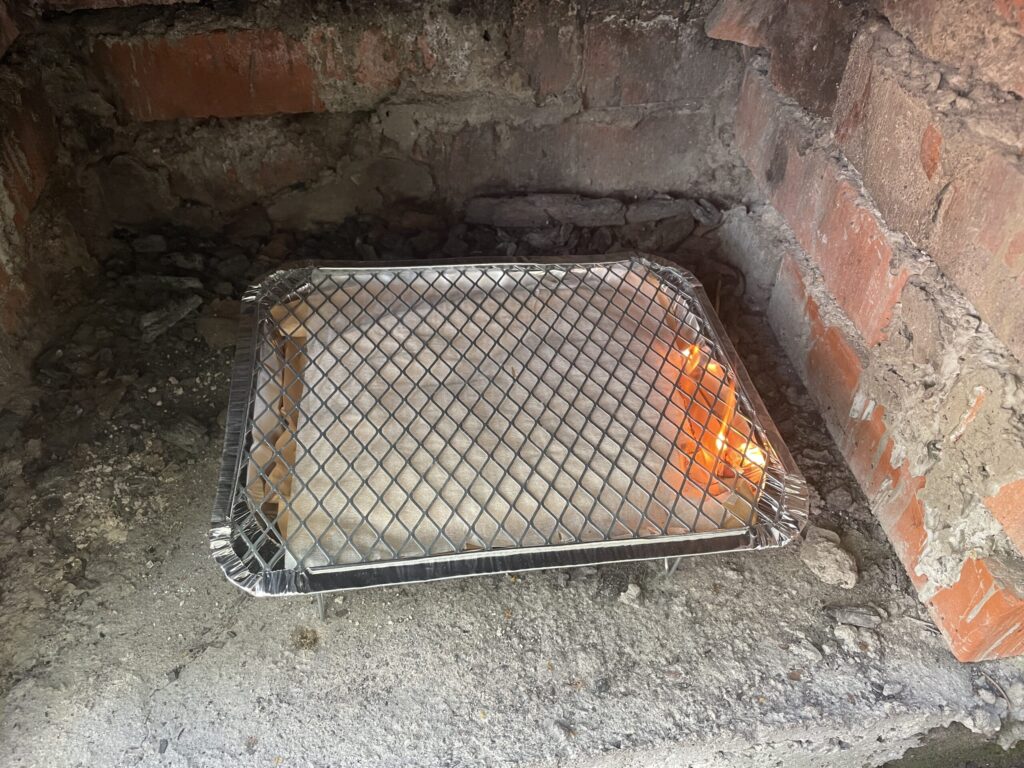
London Fire Brigade said the ban followed a grassland fire in south London that took 60 firefighters and was believed to have started with a disposable barbecue. The brigade noted that the heat from one can be retained for many hours after people believe they have put it out safely.
Wild Fires in Wales
Wales Wildfire Board figures show fire services across Wales attended 3,474 grass fire incidents in 2025, an increase of 275% on the previous year. Of those, 2,357 were recorded as deliberate.
That works out at roughly two in every three grass fires being set on purpose. An alert telling people not to light barbecues addresses the other third. The rest is an arson problem, which is why every fire service statement this week pairs 999 with the 101 number.
Deliberate grass fires alone rose by 1,694 incidents year on year, a 256% increase. Against that background the Welsh Government has called this summer’s fires unprecedented, and both Welsh services are now running on mutual aid from other UK fire and rescue services.
What Happens Next
The alert is a warning rather than a restriction with an end date. It stays relevant for as long as the ground stays dry, and the disposable barbecue guidance is to be kept under review. The Secretary of State has also written to English councils about orders limiting open fires in vulnerable areas.
“Emergency Alert to be sent to England and Wales as wildfire risk remains very high.”
Emergency Alert to be sent to England and Wales as Government steps up wildfire response with funding, military support and BBQ ban.
— Antonello Guerrera (@antoguerrera) August 14, 2026
This is the eleventh real-world emergency alert the UK has sent since the system launched, and going by the government’s own list of past alerts, the first ever issued for fire. The previous ten covered wind, flooding and a wartime bomb in Plymouth.
Summer heat has already reshaped travel across Europe this summer, we recently covered this in our article about Eurostar Heat Wave Cancellations and FCDO travel warnings. The ongoing risk is something all travellers and holiday makers should think about before travelling. Especially to remote locations or areas they are not familiar with.