What is driving in Montenegro like?
Driving in Montenegro is the best way to see the country, and a small hire car handles it easily. The roads range from a single-lane ledge around the Bay of Kotor to fast inland bends and one short tunnel toll. We drove a hired Renault Clio for seven days in May 2026, covering about 400km from Dubrovnik down to Lake Skadar and back through Bosnia.
The driving is busier and faster than in the UK, but rarely aggressive. Locals overtake in tight spots, skip indicators, and use the horn as a friendly hello rather than a complaint. This guide covers the roads, the ferry, fuel and tolls, parking, the local driving style, and the cross-border legs into Bosnia.
We picked the car up near Dubrovnik and crossed straight into Montenegro, so the first hour was Croatian motorway followed by a border queue. If you want the full account of the hire itself, we wrote it up in our Avenis car hire review.

Picking up the car and crossing the border
We collected the Clio near Dubrovnik on a stormy morning, with heavy rain the whole way to the border. Croatian roads were quiet and well surfaced, so the first 40 minutes were easy. The hold-up was the crossing itself: about an hour in the queue at Debeli Brijeg, the main coastal border into Montenegro.
The wait was the queue, not the check. Once at the booth the process was quick, a passport check and a wave through. Since 10 April 2026 the EU Entry and Exit System has been live on the Croatian side, which adds time on busy days. Have your passport and the car’s Green Card insurance ready before you reach the window.
Cross-border hire needs the right paperwork, so tell the rental company in advance if you plan to drive into Montenegro and Bosnia. Our Clio came with a Green Card that covered all three countries. UK passport holders need no visa for Montenegro or Bosnia.

Once we were across, the change was immediate. Road quality dropped a little, and other drivers were noticeably more relaxed about lanes and gaps. The Adriatic Highway runs straight into the Bay of Kotor from here, and most journeys around the bay use the ferry.
The Kamenari to Lepetane ferry
The Kamenari to Lepetane ferry crosses the narrowest point of the Bay of Kotor and saves about 30km against driving round. It costs 5 euros per car, runs 24 hours a day all year, and the crossing takes about ten minutes. You buy the ticket at the booth as you board, by cash or card.
We crossed during the storm, which made it good fun rather than stressful. Ferries leave as they fill, every 10 to 15 minutes in daytime, so we waited only a few minutes. Pedestrians and cyclists ride free. In peak summer the queue can reach 45 minutes, so it pays to cross early or late.
The ferry operator publishes the current timetable and fares. On the far side, the road quickly narrows to the single-lane stretch that runs right along the water.
Driving the Bay of Kotor road
The inner Bay of Kotor road is a once-in-a-lifetime drive and the highlight of the trip. For long stretches it is a single lane with the bay directly beside you and no barrier between the road and the water. It is slow going, and you stop often to let oncoming cars through.

The tightest moment was meeting the local Blueline bus head-on. There was just enough room to ease past with the wing mirror almost over the water, while the bus driver waved us through. This is where the local habit of a quick beep makes sense: it is a heads-up on a blind bend, not a telling-off.

Above Kotor the road climbs the famous serpentine in a series of hairpins. We noticed red and white painted kerbs on the bends, which mark it out as a race course. It is the Kotor to Trojica hill climb, a round of the FIA Central European Zone Hill Climb Championship run on the 4.35km serpentine above the bay. A quick search turned up onboard videos of cars attacking the same bends we crawled up.

Take the climb slowly and use the passing places. Tour buses and slow trucks use it through summer, so overtaking is rarely worth it. The viewpoints at almost every turn are reason enough to stop rather than rush.
What is the local driving style like?
Montenegrin drivers are fast and confident, but not aggressive. They overtake in tighter gaps than UK drivers would attempt, often skip indicators, and sit closer behind than you might like. Once you expect it, it stops being a worry and you just leave more space.
The horn is the clearest difference from home. In the UK a beep usually means annoyance; in Montenegro it is a hello, a thank-you, or a warning on a blind corner. Official advice is to use the horn only to avoid danger, but in practice a friendly tap is normal and useful on the narrow roads.
A few rules are worth knowing. You drive on the right and overtake on the left, the opposite of the UK. Dipped headlights are required day and night, with a 30 euro fine if you forget. The drink-drive limit is 0.03 percent, well below the UK level, so treat it as zero. Speed limits are 50km/h in towns, 80 on rural roads, and 130 on the one motorway, with on-the-spot fines and frequent checks.
One handy local signal: an oncoming driver flashing their headlights usually means police ahead, not a complaint. The RAC country guide sets out the full rules if you want to read up before you go.
The coast roads and inland bends
Away from the bay, the coast road south toward Budva is wider and quicker, with long sweeping bends and big sea views. It is well surfaced and easy to drive, though busy in both directions through the day. The sea sits below you for much of it, opening up between the headlands.

South of Budva the road keeps climbing and dropping through green hills, with frequent pull-ins for photos. We stopped above the coastline near Sveti Stefan, where a roadside barrier gives a clear line down to the island. The surface here was good, the bends predictable, and the traffic lighter than around Kotor.

Inland the roads open out further. The run toward Lake Skadar and Podgorica mixes fast two-lane stretches with the odd rough back road. The GPS will happily send you down a gravel track if you let it, though none of it troubled the small Clio.

The drive up to Pavlova Strana
The narrow switchback up to the Pavlova Strana viewpoint sounds worse than it is. Online reviews warn about the single-track road and tight turns, but at a slow pace it was easy enough, and we met no oncoming cars on the way up. The viewpoint sits above Rijeka Crnojevica and looks down on the Lake Skadar horseshoe bend.

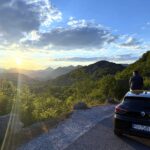
We timed the climb for late afternoon and reached the top for sunset, which is the best light for the view. There is a small parking area beside the road and a short walk to the platform, with a 2 euro charge. The drive itself is the reward as much as the view: a few kilometres of quiet hairpins with the valley opening up below.

Fill up before you head inland. The last reliable petrol before the lake shore is in Rijeka Crnojevica, and there are no stations once you are on the narrow roads above the water.
Fuel, tolls and parking
Fuel, tolls and parking are all cheap and simple in Montenegro. Petrol ran at about 1.50 euros a litre, close to UK and Croatian prices, and most stations took cards. There is only one toll on the main routes, and parking in Montenegrin towns was easy throughout.

The single toll we paid was the Sozina tunnel, which costs 2.50 euros for a car. You pay at the booth by cash or card, and it shortens the run between Podgorica and the coast. Every other road, tunnel and bridge we used was free. There is no vignette or sticker system to buy.
Parking was the easy part of the trip. Kotor, Budva and the inland towns all had plenty of space, and we never struggled to find a spot. That changed once we crossed into Bosnia, which is the one place we would warn you about.
The cross-border leg into Bosnia
The detour up to Trebinje in Bosnia was worth it, though it felt different to Montenegro. The Montenegro to Bosnia crossing was quick and very quiet, a contrast to the hour we lost coming in from Croatia. The Bosnia to Croatia crossing on the way home was fast too.

Parking in Trebinje was the one genuinely stressful moment of the week. Bosnia uses the convertible mark rather than the euro, English is less widely spoken, and wardens were actively clamping cars while we were there. We played it safe and parked on the outskirts, then walked in.

Trebinje itself made the detour worthwhile, a quiet town on the Trebisnjica river with a bridge and an old centre. If you add Bosnia to a Montenegro road trip, sort your parking first and carry a few marks in cash. We based ourselves in Kotor for most of the week, at the Hyatt Regency Kotor Bay resort.
Is driving in Montenegro worth it?
Yes. Hire a small car and you will be fine, even on the narrow bay road and the switchbacks. Driving gave us the freedom to reach the Lake Skadar viewpoints, the back-road stops and the Bosnia detour, none of which are easy by public transport. A confident driver will enjoy it; a very nervous one might find the coast in peak summer hard work.
The Bay of Kotor road alone is reason enough to drive yourself. Pair a small, manual-friendly car with an early start to dodge the worst queues, and the rest takes care of itself.
Pros
- The Bay of Kotor waterside road is a genuine one-off
- Fuel, tolls and parking are cheap and simple in Montenegro
- A small car reaches viewpoints and back roads tours cannot
Cons
- The Croatia border queue cost us about an hour
- Parking in Trebinje, Bosnia, was stressful with active clamping
- The coast gets busy and fast in peak season
Is driving in Montenegro safe for tourists?
Yes, driving in Montenegro is safe for a confident driver. Roads are mostly two-lane and well signed, though the Bay of Kotor stretch is narrow with no barriers. Locals drive fast and overtake in tight gaps, so leave plenty of space and take the mountain bends slowly.
Do you need a 4×4 in Montenegro?
No. We drove a small Renault Clio for the whole trip, including the Kotor serpentine and the switchback up to Pavlova Strana. A small car is actually better than a large one on the narrow roads and in town car parks. Pick something easy to place on a single-lane road.
How much are tolls and fuel in Montenegro?
The only toll on the main routes is the Sozina tunnel at 2.50 euros per car, paid by cash or card at the booth. Petrol runs at about 1.50 euros a litre, close to UK prices. The Kamenari to Lepetane ferry across the Bay of Kotor costs 5 euros per car.
Can you drive a hire car from Croatia into Montenegro?
Yes, but tell the rental company in advance so they issue the right paperwork and a Green Card. We drove a Croatian hire car into both Montenegro and Bosnia without trouble. The main coastal border at Debeli Brijeg can be slow, so cross early or late in summer.
What is the driving like around the Bay of Kotor?
The inner bay road is single-lane in places, with the water right beside you and no barrier. You stop often to let oncoming traffic past, and meeting a bus is a tight squeeze. It is slow and memorable rather than dangerous, as long as you take it steadily.