The Montenegro and Balkans road trip
This Montenegro road trip runs over six days and 600 kilometres from Dubrovnik down through the Bay of Kotor, on to Skadar Lake, across the border into Bosnia for Trebinje, then back to Croatia for a final night in Cavtat. We drove it in May 2026 and would highly recommend it for anyone that wants to explore the Balkan states.

This is a road trip for people who want variety over a resort week. In five real driving days you get UNESCO old towns and mountain viewpoints, fresh fish dinner by the lake and a horseback ride through the hills, a hilltop monastery in Bosnia and warm burek from a village pekara that costs less than your coffee.
We booked our car at Dubrovnik Airport with Avenis Car Hire, stayed three nights at the Hyatt Regency Kotor Bay, two nights at Rooms Dujeva Drago on Skadar Lake, and one at a small guesthouse in Cavtat. Everything on this route is easy to book a few weeks out. For more informationabout driving in Montenegro check out our companion guide.
What is the Montenegro road trip route?
Our Montenegro road trip runs Dubrovnik to the Bay of Kotor to Skadar Lake to Trebinje in Bosnia, then back to Cavtat, over six days and roughly 500 to 700 kilometres of driving. You can compress it to five days by dropping the rest day at Kotor, or stretch it to seven by adding a night in Trebinje or Cavtat.
- Dubrovnik Airport (car pickup, Avenis)
- Kamenari to Lepetane ferry across the Bay of Kotor
- Kotor Old Town and the cable car up to Monte 1350
- Trattoria di Radenko, Sutomore, lunch on the drive south
- The Old Olive Tree at Mirovica
- Stari Bar Old Town
- Skadar Lake
- Rijeka Crnojevića for the Skadar Lake boat trip
- Restoran Savina Luka, fish dinner in Rijeka Crnojevića
- Mountain Riders horse ride at Komanska Utjeha
- Arslanagić Bridge and Trebinje Old Town, Bosnia
- Hercegovačka Gračanica monastery, Trebinje
- Cavtat and dinner at Konoba Kolona
You cross three borders (Croatia to Montenegro to Bosnia to Croatia), so a hire car with cross-border cover is essential.
Where do you fly into?
Fly into Dubrovnik. It puts you 15 minutes from the Montenegrin border and 20 minutes from Cavtat, which is where the trip ends. Podgorica Airport is the other option, but it drops you three hours from Kotor and there are no direct UK flights, so you would trade the driving time you save later for time you spend at the start.
We flew from Heathrow Terminal 5 on British Airways and used Maple Parking Meet & Greet at T5, then spent the pre-flight hour in the BA Galleries Club T5B lounge. Both are covered in their own reviews if you want the detail. Dubrovnik Airport itself is small and easy; the Avenis desk is straight through arrivals, and you should have your driving licence, passport and card ready as you walk up.
Picking up the hire car
We used Avenis Car Hire at Dubrovnik Airport and got a Renault Kadjar automatic for the week. The full pickup review sits in that article. The two things that matter here are that Avenis include the cross-border permit and Green Card insurance for Montenegro and Bosnia at no extra cost on longer rentals, and that the paperwork is genuinely straightforward. Ask for the Green Card certificate at pickup, keep it in the glovebox with your rental agreement, and have it out when you reach the border booth.
If you have not driven in the Balkans before, read our companion piece on driving in Montenegro before you go. Roads are good, but the mountain sections are narrow with hairpins, and Google Maps will occasionally try to route you down a gravel track. Keep to the main road as marked on the physical signs; that is what the locals do, and it is what your hire-car insurance expects too.

The Kamenari to Lepetane ferry shortcut
From Dubrovnik Airport you drive south for about 90 minutes to the entrance of the Bay of Kotor. There, at the small village of Kamenari, you have a choice. Drive right around the outer bay via Kotor Old Town, which is 40 kilometres of coastal road with peak-season traffic, or drive onto the Kamenari to Lepetane ferry and cut across the strait in ten minutes. Take the ferry. It saves 40 minutes on a good day and more than an hour when Kotor is jammed.
It costs €5 for a small car, pedestrians go free, and it runs 24 hours a day almost continuously. The crossing itself is a proper Bay of Kotor moment: you sit on deck with the mountains rising on both sides, church spires along both shores, and you understand why this bay is a UNESCO site. Ten minutes later you drive off at Lepetane and the Hyatt is fifteen minutes north along the coast road.
Book nothing in advance. Pull up, buy a ticket at the harbourside booth, and follow the loader onto the boat. In May the queue was five minutes. In peak summer it can be much longer, but even then the ferry is faster than the road round, and the boarding is well organised: a marshal waves you into your lane, cars fill the boat from the middle out, and you can leave the vehicle to stand on deck if you want the view.
Kotor Bay and the cable car: our brief take
Kotor is not a stop, it is a base. We spent three nights on the bay and covered the details in our nine best things to do in Kotor: the Old Town walk, the cable car up to Monte 1350, the alpine coaster next to it, the city walls hike, and the Kotor Coaster ride back down.

The one thing we will repeat is the cable car sunset. Take the cable car up in the late afternoon, buy a return ticket for €23, sit at the Monte 1350 Bar for two hours with a drink, and stay until the sun drops behind the far mountains. The bay faces west from up there, so the whole town lights up as the sun goes down. The opposite of the morning, when the mountains block the light in the wrong direction.

Time the last cable car down carefully. The last car in season goes at 20:00, and the queue at the top station builds fast after sunset. Aim to be back at the station 15 minutes before the last car, or you will be walking down: it is a 90-minute descent on a rough trail and it gets dark quickly under the trees.
If you can spare a morning, the alpine coaster next to the top station is worth it too. It looks like a fairground add-on and it is fun rather than serious, but the ride down through the mountain trees is a proper €10 of adrenaline.

Where to stay in the Bay of Kotor
We stayed three nights at the Hyatt Regency Kotor Bay Resort, a five-star at Donji Stoliv on the western shore of the inner bay. Full review at that link. The shorthand is that it is comfortable, well run, and the pool jetty out over the bay is the reason to book it. Our companion guide has the room, the food, the price and the honest verdict.
Alternative: the Old Town itself has small guesthouses and apartments. They are nice for one night to hear the church bells and step onto the stone streets from your door, but hard for parking (you leave the car in a paid lot outside the walls, then wheel your bag in) and shopping (the small grocery shops close at 21:00).

Drive south to Sutomore: lunch at Trattoria di Radenko
The morning after the cable car sunset we set off south down the coast. The road runs through Budva (touristy, worth a lap), past Sveti Stefan (photo stop from the viewpoint above, not the resort itself, which is closed to the public), and along the coast to Sutomore, a small resort town on a wide beach.
Lunch stop: Trattoria di Radenko, on the seafront at Obala Iva Novakovića 24. Family-run by Radenko and his wife Nataliia, open 07:00 to 23:30, blue-check tablecloths on a shaded terrace one table back from the beach.

Order one fish dish and one meat platter and share both. We had a creamy seafood pasta with prawns and a schnitzel-style pork with prosciutto, kajmak cheese, roasted potatoes in a fryer basket and a bowl of tartar. The fish is fresh off the boat that morning, so ask what came in. Prices in May 2026 were €12 to €18 for a main, and both cash and card work. If you are running the itinerary as a lunch stop, aim to arrive around 12:30.

Should you bother with the Old Olive Tree?
Fifteen minutes worth. The Old Olive Tree of Mirovica (Stara Maslina) is signposted off the road between Sutomore and Stari Bar, and it is genuinely one of the oldest living trees in Europe at over 2,000 years old. Entry is €1, cash only. There is a wooden platform round the trunk to protect the roots, an info board with the carbon-dating detail, and a couple of benches.

The honest verdict: it is a tree in a walled garden with a small info board. Most reviewers, ourselves included, come away feeling the setup is more modest than the age suggests. You look, you nod, you leave. What saves the stop is that Stari Bar is 500 metres up the road, so you are already parked and paying for the same lot. See the tree, take the photo, walk on to the fortress. Skip it entirely if you are pressed for time and go straight to Stari Bar.
Stari Bar: our favourite ruined city on the coast
Stari Bar was the surprise of the trip. Entry is €5, open 08:00 to 20:00 in summer and 09:00 to 17:00 in winter, and you park in the paid lot at the bottom for about €0.60 per hour. Allow two to three hours; longer if you like reading the info boards, which are good. Bring water and a hat: there is a café at the entrance but nothing on the site itself, and the stone reflects the sun back at you all afternoon.

Stari Bar is not a museum, it is a real ruined city. About 240 stone structures on a rocky outcrop, abandoned after an earthquake in 1979 and left as you find it. You walk in through the main gate under the clock tower and the paths climb up through Ottoman mosque ruins, Venetian Gothic arches, a Byzantine chapel and roofless stone houses reclaimed by cypresses and ivy. Small brown info boards at each ruin identify the century and the purpose, so you can move through it at your own pace and read as much or as little as you want.

From the citadel at the top you can see the modern town of Bar down on the coast, the Adriatic beyond, and the Rumija mountain massif behind. The Ottoman market street on the approach to the main gate is still lined with cafés and small shops selling straw hats, olive-oil soap and pomegranate juice; it is a good spot for a break on the way in or out, and the pomegranate juice is genuinely excellent if you have not had it fresh before.

The aqueduct outside the town walls is the best-known image of Stari Bar, and it is worth walking down to see. It is about a kilometre out of the main gate along a signposted dirt path, and it takes 20 minutes each way. Wear proper shoes for the loose stone underfoot. Go earlier in the day if you can, the site sits on a south-facing slope and the afternoon sun on the stone is fierce from June through September.

Up the windy road to Rooms Dujeva Drago on Skadar Lake
From Stari Bar you climb inland on the winding road up to Skadar Lake National Park. The drive takes about two hours and gets more beautiful as you go: the coastal scrub gives way to olive terraces, then to bare karst limestone, and finally to the wetland valley of Skadar itself. The road is properly surfaced the whole way, but it is single-lane in places and slow.

Somewhere above Virpazar you get your first view of Skadar spread out below in the valley. It is worth pulling into the layby at the Pavlova Strana viewpoint (well signposted, small dirt pull-off on the left) for the classic river-bend photo. The Rijeka Crnojevića river loops back on itself hundreds of metres below, framed by mountains on all sides. Ten minutes there is enough. From the viewpoint it is another 40 minutes on to Rijeka Crnojevića itself, and then a short steep climb up to Dujeva.

We stayed two nights at Rooms Dujeva Drago, a small family-run guesthouse in the hamlet of Dujeva above Rijeka Crnojevića. Full review at that link. The short version: we preferred it to the Hyatt, which tells you something given what separates them on price.
Dinner on the terrace with the river-bend view was our favourite meal of the trip. The last of the light drops behind the ridge across the valley at around 8pm in May, so aim for a 7pm sit-down and stay for it. Kitchen is home-cooking, so order what the host recommends that day rather than sticking to what you know. The trout from the river and the grilled lamb both came lovely.

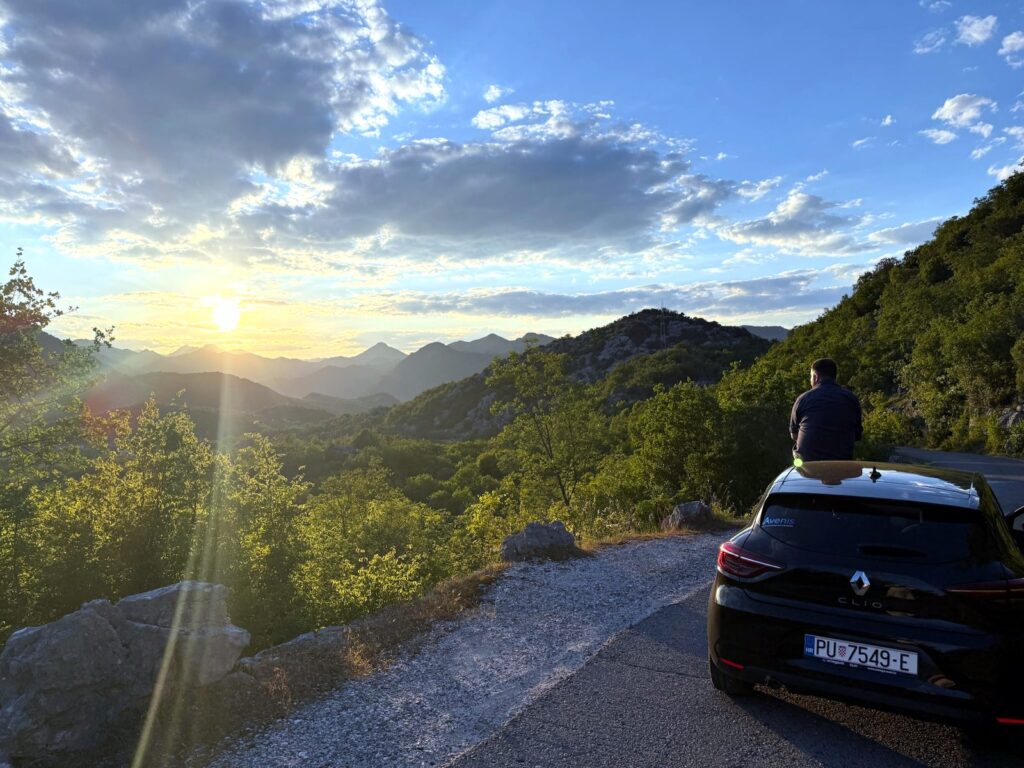
The road up to Dujeva from Rijeka Crnojevića is single-track, steep, and has a run of hairpins that a nervous driver would find hard work. A small car is actually better than a large one. The hairpins are tight enough that a full SUV needs a three-point turn on a couple of them. Go slowly, use low gear on the descent to save the brakes, and it is fine. From the guesthouse we did not touch the car for the whole of Day 4 apart from a run to the ranch and back.
The Skadar Lake boat trip and dinner at Restoran Savina Luka
On the afternoon of Day 4 we did a Skadar Lake boat trip arranged through Rooms Dujeva Drago. Full article at the link. In short: a two-hour trip from the shore at Rijeka Crnojevića out through the reed channels almost to the open lake, watching herons, cormorants and (with luck) kingfishers. €50 in cash for the two of us, no ticket booth, cash direct to the boatman.

The engine cuts and you drift for a while, which is when the birdlife actually shows itself. It is one of those experiences that ends up in the “why did we not know about this?” category. Bring a hat, sunblock, and cash. Do not expect commentary. The boatman steers and lets the lake do the talking, which is the right call. If you want a guided ecology tour, book one of the operators at Virpazar instead; it will not be as good but it will have narration.

We finished the day with dinner at Restoran Savina Luka, directly opposite the boat mooring on the Rijeka Crnojevića waterfront. Grilled trout from the river is the order, done simply with olive oil, blitva greens and boiled potato. €18 got us the fish, a salad, a glass of local wine and a shot of home-made rakija the owner brought over unprompted at the end. The terrace only takes about six tables and the locals have most of them by 8pm, so book if you can.
Horse riding at Mountain Riders
Do this. Mountain Riders run half-day and multi-day rides in the hills above Podgorica, on local mountain horses that stay sure-footed on rocky ground and do not spook. Suitable for absolute beginners. They match the horse to your experience, and every ride goes out with an English-speaking guide. You do not need to have ridden before; the introductory ride is a walk-and-trot pace on well-worn trails with genuinely lovely scenery.

The insider fix: if you look up Mountain Riders on Google Maps you will be pinned to Vučje, near Nikšić. That is their old registered address. The actual ranch is at Komanska Utjeha in the hamlet of Oraovica, in the Komani hills 15 minutes northeast of Podgorica. It is 40 kilometres from the Google pin. Message them through their website (mountainriders.me) or WhatsApp them before you go, and they will send you the correct pin.

Booking is essential. The ranch runs to a schedule and they will turn you away without one. Email through the website a few days ahead; they answer quickly. A two-hour ride is the standard start, longer rides for confident riders, and multi-day treks if you want the full expedition. From Rooms Dujeva Drago the drive to Komanska Utjeha is about an hour, so you can do the ride in the morning, be back at the guesthouse for lunch, and do the boat trip in the afternoon.

Crossing into Bosnia: Trebinje
Day 5 you leave Skadar Lake and drive to Trebinje in Bosnia. The direct route is around three hours across a couple of mountain passes, and the road is quiet all the way. You might not see another car for stretches of it. The border into Bosnia from Montenegro was our fastest crossing of the trip, ten minutes even in daylight. The Bosnian side does a quick passport and hire-car paperwork check and waves you through.
Trebinje itself is a small Herzegovinian town on the Trebišnjica river, ringed by vineyards and hills. It is quiet, cheap by regional standards, and easy to walk.

Trebinje Old Town (Kastel) is a compact square of Ottoman stone streets running down to the river. Cafés on the river bank do proper Bosnian coffee for €1.20, served the traditional way with a copper džezva and a small glass of water. The market square in the middle is the spot to sit for an hour: shaded by huge plane trees, ringed by low stone buildings, with a working market on weekend mornings. Cross the Old Bridge on foot for the postcard view of the town from the water.
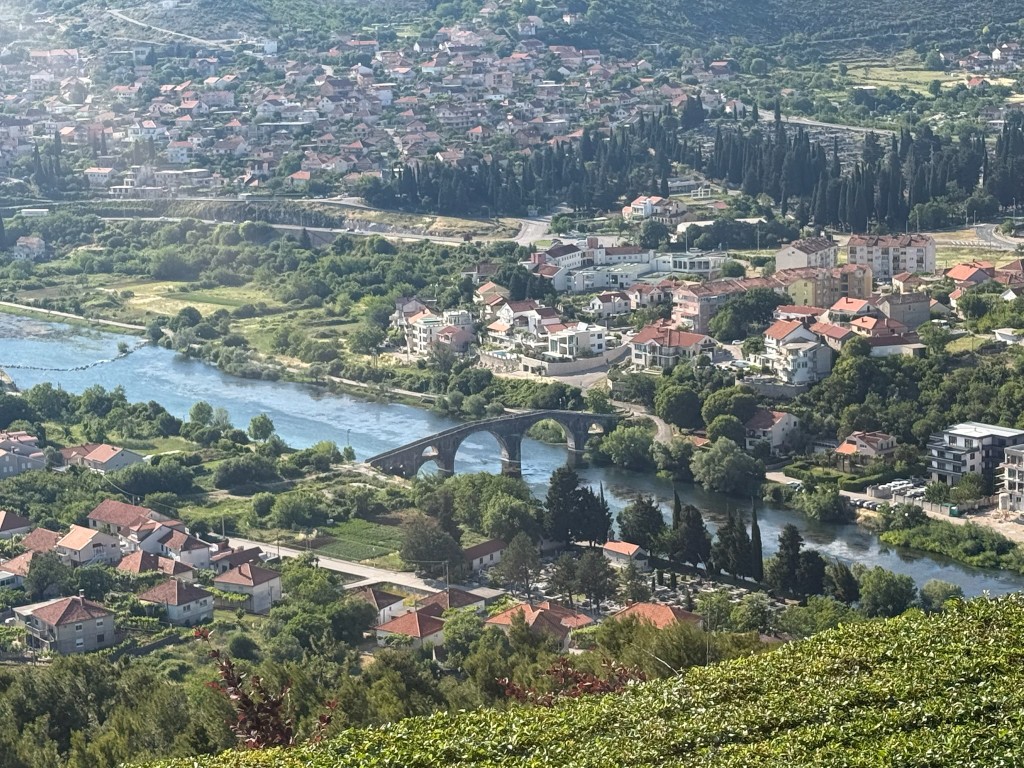
Arslanagić Bridge (also called Perović Bridge) is a 16th-century Ottoman stone bridge with two big arches over the Trebišnjica, moved stone by stone in 1972 when a reservoir was built upstream. Pedestrian only, half a kilometre downstream from the Old Town along a signposted riverside path. Free, open all hours. Sunset gives you the best light on the arches, and there is a small bar on the far side that catches the last of the sun for a beer.

Hercegovačka Gračanica is the Serbian Orthodox monastery on Crkvina Hill above the town. Completed in 2000 and a faithful replica of the 14th-century Gračanica in Kosovo, it is the resting place of Serbian poet Jovan Dučić, whose crypt is inside the church. Free entry, open 07:00 to 20:00. Walk up from the Old Town (30 minutes uphill, well signposted), or drive up and park at the top.

The views over the town, the vineyards and the river bend are the best in Trebinje, and there is a café-restaurant (Dučić’s View) at the monastery for a coffee before or after. If you can stretch the itinerary to a night in Trebinje, do. The town at dusk is one of the quieter pleasures of the whole route, and Bosnian dinner prices are roughly half what you pay in Cavtat the next night. However parking can be a pain in Bosnia, you require cash and the signs aren’t in English, plus they clamp regularly so park just of town and walk in.
Cavtat for the final night, dinner at Konoba Kolona
From Trebinje you drive to Cavtat in about an hour, back through the Bosnia to Croatia border. Cavtat is a small port town on a peninsula seven kilometres from Dubrovnik Airport, so it is where you spend your final night before flying home. Palm-lined promenade, small harbour, a couple of stone churches, and Villa Račić’s mausoleum on the peninsula tip for a 20-minute walk with a view back to Cavtat. Quieter than Dubrovnik and cheaper by a third for a comparable room.

Dinner at Konoba Kolona, one street back from the promenade. Family-run since 1985. Book ahead in season. The terrace only takes about eight tables and the locals fill it quickly on Fridays and Saturdays. Ask for the grilled fish of the day and order a side of blitva (chard sautéed with potato, olive oil and garlic; a Dalmatian staple you should try if you have not before). Mains €15 to €25 in May 2026, cash or card both fine.

The lamb “under the bell” (Slow-cooked under an iron bell in embers) is the other order if you have called earlier in the day so they can start the fire. It needs three hours minimum, so ring at lunchtime. There is live jazz on some evenings and a wooden terrace at the front.

The Pekara rule
Simon’s rule for driving Montenegro: stop at as many pekaras (bakeries) as possible, and take whatever is still warm. Do not go to the chains. The good ones are the small village pekaras with a queue of locals out the door at 08:00. If you see steam coming off a tray in the window, park.
Burek (savoury filo with meat, cheese or spinach) is the standard for a €2 breakfast on the road, but the sweet pastries, the krofne (Balkan doughnuts) and the fresh bread rolls are all reasons to pull over. Coffee at pekaras is usually good and about €1.
The practicalities you will actually need
Borders. You cross three: Croatia to Montenegro, Montenegro to Bosnia, Bosnia to Croatia. In May 2026 the last two were quick, ten minutes each. The first one caught us out. Croatia to Montenegro at Granični Prijelaz Vitaljina took us over an hour, because Vitaljina is a small secondary crossing and Croatia is now full Schengen so passport control on the way out is thorough. Allow at least an hour in peak summer.

If your route allows, take the main crossing at Karasovići to Debeli Brijeg instead. It has more booths and is generally faster off-season, though it can back up two to three hours in July and August. Check both on Google Maps live traffic before you set off, and take whichever is moving. In peak summer: cross before 08:00 or after 20:00 whichever crossing you use.
Cash. Once you leave Kotor and the coast, you are in cash territory. Rooms Dujeva Drago, the boat trip, the horse ride, the pekaras and most small restaurants take cash only. Montenegro uses the euro; Bosnia uses the convertible mark but the euro is widely accepted at some border towns. Bring at least €300 in euros per person to cover the inland stops, and top up at an ATM in Bar or Podgorica before you head up to Dujeva. There is no ATM in Rijeka Crnojevića village.
Fuel. Montenegro petrol was about €1.60 per litre in May 2026, Bosnia about the same. Pay the pump attendant, either cash or card. Fill up before the mountain drives; stations get sparse above Skadar and there is a 40-kilometre stretch between Rijeka Crnojevića and the Komani hills with nothing on it.
Driving. Roads are good; the mountain sections are single-lane with hairpins and occasional overtakes on blind bends by locals who know every centimetre of the road. Go slowly, use the horn on hairpins as the locals do (it is not aggression, it is a warning to anyone coming the other way), and do not try to keep up with the locals!
Navigation. Google Maps will occasionally try to route you down a farm track that looks like a shortcut on the map and is a goat trail in reality. Cross-check the physical road signs. Waze can be better in Montenegro because the traffic data is more current. Download offline maps of Montenegro, Bosnia and southern Croatia before you go; mobile signal drops out in the mountain sections.
Best time to go. May and September are the sweet spot: warm enough to swim, cool enough to walk Stari Bar in the afternoon, borders manageable, and the cable car and coaster both running. April is cooler and the cable car may still be closed for winter maintenance. July and August are hot (35°C on the coast is normal), the queues at Karasovići get long, and every restaurant on this itinerary needs booking ahead.
Would we do this trip again?
Probably. The Skadar Lake half is what stays with us: a small guesthouse with a river-bend view, a boat trip that we half expected to be a tourist queue and turned out to be quiet, a horse ride in hills we would never have found ourselves, a fish dinner opposite where the boat pulled in. Kotor is Kotor. Worth doing once, and we would not fight to do again.
If you want a resort week with a couple of trips, this is not that route. If you want the drive to be the point, and you are happy to eat where the tablecloth is check-blue and the fish arrived that morning, it is exactly that route. Pair a small car with an early start and the rest takes care of itself.
Frequently asked questions
How long do you need for a Montenegro road trip from Dubrovnik?
Six days is the sweet spot, five if you drop the rest day at the Bay of Kotor. Any less and you spend more time driving borders than seeing places. Seven days lets you add a second night in Trebinje or Cavtat.
How much does the Montenegro road trip cost per person?
Budget €800 to €1,200 per person for six days, excluding flights. That covers a five-star Kotor Bay stay at around €250 a night, the guesthouse on Skadar at around €60 a night, fuel, ferries, all entry fees and a couple of the food splurges we mention. Cheaper stays in Kotor bring the total down to €500 to €700 per person.
Do I need to speak the language?
No. English is widely spoken in Kotor, Cavtat and at Rooms Dujeva Drago. Off the coast it thins out and a phrasebook helps. Learn “hvala” (thanks), “dobar dan” (good day) and how to point at the menu. You will be fine. We learned a little Serbian before the trip and the guesthouse hosts were touched by it.
Is it safe to drive in Montenegro?
Yes for a confident driver, no for a nervous one. Main roads are good; mountain sections are narrow with steep drops and hairpins. Locals overtake on blind bends. A very nervous driver would find the coast in peak summer hard work.
Can I do the Skadar Lake boat trip as a day trip from Kotor?
Yes, but it is a hard day. Rijeka Crnojevića is 90 minutes from Kotor each way, then a two- to three-hour boat, plus a proper lunch. Better to stay a night on the lake and do it properly. Rooms Dujeva Drago and Skadar are made for each other.
What is the best month for a Montenegro road trip?
May or September. Warm enough to swim, cool enough to walk Stari Bar in the afternoon, borders manageable, everything open. April is cooler and the cable car may still be closed. July and August are hot and the queues at Karasovići get long.