Where to stay in Chamonix
We stayed at UCPA Chamonix in the centre of the valley, which turned out to be a convenient base. UCPA are a hostel-style accommodation where everything is included. Great for first-timers and solo travellers. However, not luxury but budget-friendly ski accommodation.
If you want your own room or accommodation, there are plenty of options in Chamonix. With everything from apartments to hotel rooms and bed and breakfasts. Getting the best price depends on whether your accommodation includes a lift pass and discounted ski equipment hire. Do the maths for buying as separates or as a package to find the best ski accommodation deal in Chamonix.

Getting to Ski Areas from Chamonix
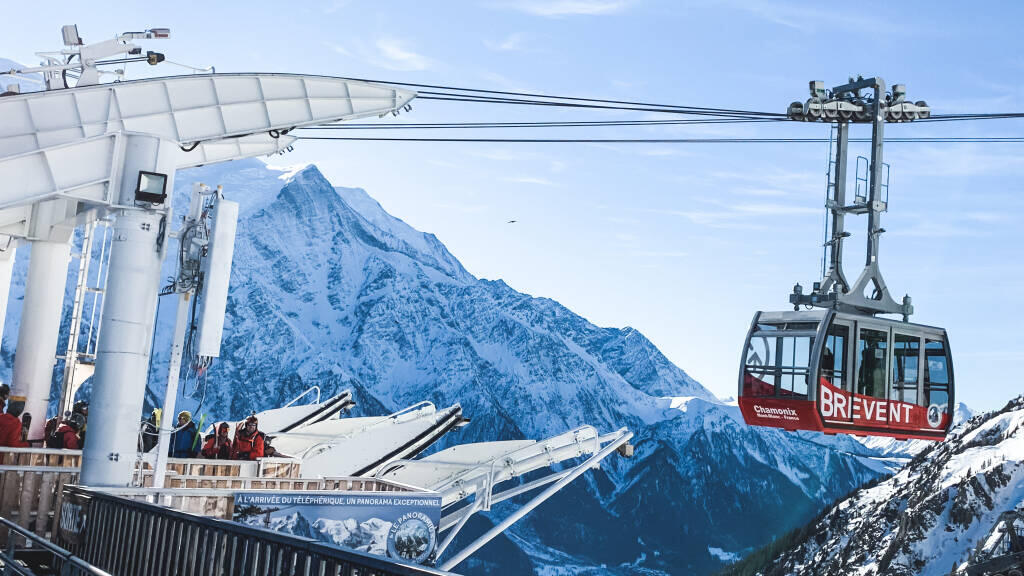
Everything in this guide is written from the centre of Chamonix. The walk to the nearest lift up to Le Brevent is under ten minutes. The bus and train connect you to the rest. You do not need a hire car to get around; however, if you want convenience, it can be a good choice for your ski break.

What is Chamonix Ski Resort
When we first arrived in Chamonix in the evening, we felt like we were in a storybook winter town from Frozen. A river runs through the town centre, with beautiful old buildings and restaurants, plus some very expensive brand shops.
It differs from other ski resorts because it’s a real town where people live and isn’t always covered in snow. Plus, it isn’t a ski-in, ski-out resort; you will have to take the cable cars to ski or use the bus.

Chamonix Lift Pass
Before you think about any of the resorts and ski areas, the first thing to understand is the lift pass. The Chamonix Le Pass covers all the ski areas in the valley, including Brévent-Fléger, Les Grands Montets in Argentière, Le Tour and Balme, and Les Houches. The Mont Blanc Unlimited pass extends that to Megève, Les Contamines, and Courmayeur across the border in Italy, which is worth it if you are staying for a full week and want to explore further afield.

Chamonix Travel Ticket & Pass
The lift pass is also your transport ticket. You may be issued with a separate travel ticket, which will be validated by your accommodation or lift pass supplier. All Chamonix ski buses are free with a valid pass, as is the Mont Blanc Express, which connects several resort towns.

How to get to Ski Resorts in Chamonix
Getting your bearings and understanding that all ski areas in the valley require transport to reach them, and that you have to take a cable car up to them, is the biggest difference in Chamonix. It is not a ski-in, ski-out resort; travel is required to reach all ski areas.
Think of each Ski Area like a land in Disney, and that you need to plan your days out. Plus, how you’ll get there.

Getting Around: Buses and the Mont Blanc Express
The Chamonix Mobilité network covers the whole valley from Les Houches in the south-west to Vallorcine near the Swiss border. The main Ski Bus Lines you’ll need are:
SKI 1 DIRECT connects Le Prarion and Les Houches in the west with La Flégère in the east, stopping at Chamonix town centre along the way. Buses run every 30 minutes from around 08:13 to 17:13, making it the most useful cross-valley link for those mixing ski areas in a day.
SKI 2 DIRECT runs from Chamonix Sud directly to Les Grands Montets at Argentière, every 20 minutes roughly between 08:05 and 17:35. It’s the quickest way up to Chamonix’s most serious freeride terrain, reaching 3,275m.
SKI 3 DIRECT covers the same Chamonix Sud starting point but heads east to Le Tour and Balme, with departures every 30 minutes from 07:40 to 18:07. Good for families as Balme has the valley’s largest nursery slopes.
SKI 12 is the valley-wide connector running between Les Îles/Grassonnets and Le Tour, stopping at Les Grands Montets and Argentière along the way. It runs every 45 minutes from around 09:15 to 16:45, though note it only runs daily from 20 Dec to 4 Jan and 7 Feb to 8 Mar. Outside those periods it drops to Wednesdays, Saturdays and Sundays only.
SKI 14 links Les Planards on the eastern edge of Chamonix town to Le Brévent, running every 20 minutes from 08:20 to 18:00. It also stops at Montenvers for the Mer de Glace, so it doubles as a sightseeing route on rest days.
SKI 15 is the longest route on the network, running from Le Grépon parking in Chamonix town all the way out to Le Tour, calling at Les Praz Flégère and Les Grands Montets en route. Departures run approximately every 14 minutes from 08:18 to 17:18, making it the most frequent ski bus on the network and the best option for intermediate skiers wanting to cover multiple areas.
SKI 17 provides a dedicated link between Le Brévent and La Flégère, the two ski areas connected by cable car. It runs every 30 minutes from 08:30 to 17:30, operating daily from 20 Dec to 4 Jan and again from 7 Feb to 8 Mar.

Ski Bus Times
Buses run from around 07:00 to 20:00. They usually run every 30 minutes and can get very crowded! To avoid crowds, consider either going slightly later or using the train. Take your time to understand the bus routes, as there are express routes and stop at every town. Waiting for a different bus route could mean getting an empty bus with some space rather than just jumping on the first one that turns up.
After 20.00 the Chamo’nuit night bus takes over until about 01:10, though some services require advance booking and carry a small charge. Always check the last departure time before your final run of the day.

Chamonix Sud Bus Station
Chamonix Sud (the main bus station) is about a five-minute walk south of Chamonix town centre and is where almost every line passes through. If in doubt, head there. It is also wherer coaches to airports, other towns and most drop off and pick ups happen.
The free Mulet electric shuttle loops around Chamonix centre for short hops between the bus station, the Aiguille du Midi, and the main street.

Ski Bus Crowds
We did find that the ski bus can get really packed, with standing room only and everyone’s equipment held tight to them. It feels like the Central Line during the morning peak. The roads are also quite bendy, so it isn’t the most pleasant experience, especially if the driver is going quickly.

Mont Blanc Express
The Mont Blanc Express railway runs the full length of the valley from St Gervais in the west to Vallorcine on the Swiss border, with onward connections to Martigny in Switzerland. Travelling from Geneva, expect around 2.5 hours by train to St Gervais and then the Mont Blanc Express.
For skiers, the train is one of the most practical ways to reach the slopes without a car. Chamonix station sits right in the heart of town, around a 5-minute walk from the Le Brévent cable car and the Aiguille du Midi.
Further up the valley, Argentière station is around 500 metres on foot from the Grands Montets lift station, making it one of the most direct train-to-slopes connections in the valley.
For Balme and Le Tour, the nearest train stop is Montroc, about 1km from Le Tour itself, so you’ll need a short ski bus ride to reach the main lift station. The better option for Balme is to ride one stop further to Vallorcine, where the station sits directly by the gondola.

Getting to Chamonix: Airports
Which airport to fly into:
Chamonix is accessible from three airports, and the choice affects both cost and journey time considerably.
• Geneva (GVA): The main gateway for most UK travellers. Around 100km by road, roughly 1 hour 15 minutes to 1 hour 30 minutes depending on traffic and season. Easily the best option given the frequency of UK flights and the number of transfer operators running the route.
• Lyon Saint-Exupéry (LYS): Around 220km, roughly 2 hours 30 minutes to 3 hours. Worth checking if Geneva flights are expensive or unavailable on your dates.
• Chambéry (CMF): Smaller airport, mainly seasonal UK charter flights from January to March. Around 150km, about 2 hours by road. Useful in peak ski season if it works with your dates.

Getting from Geneva to Chamonix
Once you land in Geneva, you have three realistic options:
- Budget bus (FlixBus / easyBus): easyBus runs a direct service from Geneva Airport to central Chamonix, arriving at the Chamonix Sud bus station. Journey time is around 1 hour 15 minutes, and prices start from around €17 one-way when booked in advance, with a bus running roughly every 75 minutes. Good for solo travellers or pairs travelling light. Worth noting that luggage space is limited, which matters if you are travelling with a ski bag.
- Shared transfer shuttle: Operators, including Alpybus, Mountain Drop-Offs, and Alpine Fleet, run shared minibus shuttles from the airport directly to Chamonix accommodation. The typical cost is around €35-€55 per person, one-way. Ski bags and luggage are included as standard, and you get door-to-door service with no bus station connections. The best middle-ground option for most skiers.
- Private transfer: Direct from arrivals to your accommodation door, no waiting, no other passengers. Prices start from around €200 to €250 per vehicle one-way, which works out very reasonably split between four to six people. Worth it for families, groups with a lot of gear, or anyone arriving on a late flight.

Is it worth hiring a car?
For a central Chamonix stay, the honest answer is probably not. The valley bus network is free with your ski pass, covers all the resort areas, and runs frequently enough that you are rarely waiting more than 20 minutes. Parking in and around Chamonix town is expensive in peak weeks, road conditions can be challenging without the right tyres, and French law requires winter tyres or snow chains between November and March. There are also motorway tolls from Geneva, roughly €20-€30 each way.
A hire car makes more sense if you are staying outside the main town, in Argentière or Les Houches, for example, where the bus is less frequent. It also works well if you plan day trips beyond the valley, towards Megève, Les Gets, or across into Italy via the Mont Blanc tunnel.